Money Trade Based and Share Based Economies (5-Minute Speed Run)
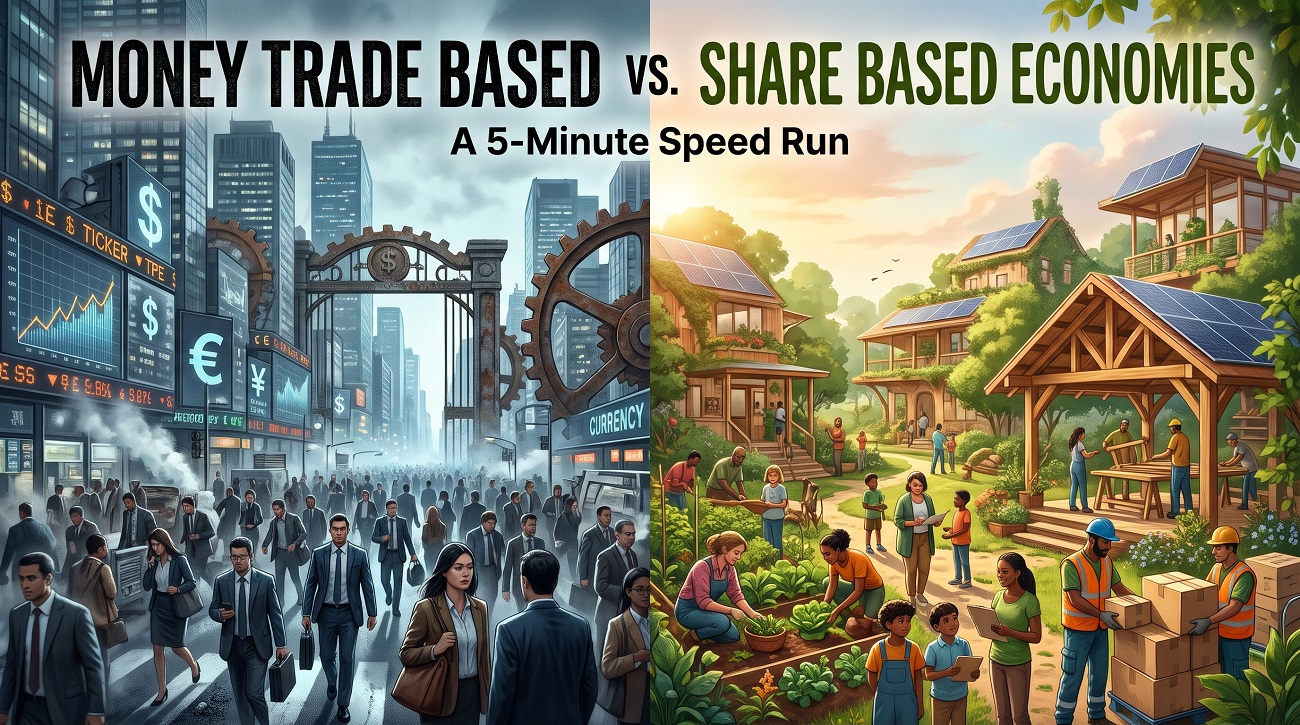
Money Trade Based and Share Based Economies (5-Minute Speed Run)
A 5-minute quick intro to a Share-Based Economy
When we need something today, our first reflex is almost automatic: What does it cost, and can I afford it?
We have lived inside that question for so long that we treat it like a law of physics. Yet there is another set of questions sitting right beneath the surface: Who can provide it? What is already available? Who would like to help?
Consider a simple scene. A teacher has free time and loves teaching. Across town, a group of students is eager to learn. The classroom exists. The knowledge exists. The human desire on both sides exists. Yet if the students cannot pay enough to cover the teacher's rent and groceries, the lessons never happen.
Stop and look at that for a moment. Nothing physical is missing—no shortage of talent, time, or need. Cooperation fails purely because a financial tollgate stands between two willing human beings.
Now imagine five hundred ordinary people surviving a shipwreck on a large, resource-rich island. Their money is wet paper. Yet life does not grind to a halt. Some explore for fresh water. Some cook. Others build shelter, tend to the injured, or keep track of who knows how to do what. Nobody demands a credit check before bandaging a wound or repairing a water container. Needs and abilities meet directly, before anyone calculates a price.
We tend to assume that this kind of sharing only works in emergencies or tiny villages—and that modern civilization must run on money-trade.
But what if the opposite is closer to the truth? What if the requirement of equivalent repayment is actually what is distorting our work, our products, and our lives?
1. The "Money Game" and the Corporate Hostage Trap
Money is harmless when it acts as a quiet, neutral ledger. It becomes something else entirely when payment is made the mandatory condition for human survival, and when money is allowed to generate more money from money itself.
Through compound interest, financial speculation, and derivatives, returns come from moving money around rather than growing, building, or repairing anything real. Because the financial game pays better and carries less physical risk than real production, capital and talent steadily drain out of the physical economy. Worse, whoever sits closest to the source of new money and credit gains first claim on foundational natural resources—land, water, energy, timber, and minerals. Once those baseline resources are locked up, everyone else is forced to sell their labor simply to access the requirements of survival.
Once survival depends on a continuous paycheck, the entire logic of human effort turns upside down:
- The Bridge-Building Paradox: Imagine a construction company that hires workers to build a bridge. When the bridge is finished, the real physical need is met. In a sane world, people could rest, celebrate, and move on to other interests. Instead, in a money-trade economy, both the workers and the company are held hostage: the workers still need salaries to eat, and the company still needs revenue to pay its overhead. So the machine must keep running—chasing endless new projects, construction, and sales, not because the community needs another bridge, but to feed payroll.
- When Durability Becomes a Threat: If a washing machine or a pair of boots lasts for thirty years, a community saves materials, energy, and thousands of hours of human labor. In a share-based economy, longevity is a triumph. In a money-trade economy, a product that lasts forever is a disaster for revenue. Because the machine requires repeat sales to survive, genuine satisfaction becomes the enemy—giving us planned obsolescence (products engineered to fail) and marketing industries devoted to packaging an ordinary stone as an exclusive "luxury" status symbol.
2. "Who Will Do the Unpleasant Work?" (The Projection Fallacy)
Whenever voluntary contribution is proposed, one objection always rises first:
"If nobody is forced to work for survival, won't everyone become an artist or sit on the beach while unpleasant work goes undone?"
Look closely at the hidden assumption inside that fear. It assumes that everyone is wired the same way you are—that what feels tedious to you must feel tedious to eight billion other people.
In reality, human temperament is as different as night and day. What we call "unpleasant work" is simply work that clashes with a particular person's sensory, emotional, or personal makeup:
- One person craves ephemeral moments of excitement and the spotlight; another feels most alive working quietly behind the scenes.
- One person thrives on open-ended uncertainty and invention; another finds deep peace in predictability, routine, and repeatable precision.
- Cooking for a hundred people, diagnosing a failing pump, or solving a sanitation problem may feel like torture to one person, while offering a deeply satisfying craft or puzzle to another.
That means "unpleasant work" is not an objective category:
- Person A's unpleasant work is not Person B's unpleasant work.
- Person B's satisfying work is not Person A's satisfying work.
An absolute "unpleasant job" that everyone hates—or a single "dream job" that everyone wants—simply does not exist. When basic survival is decoupled from wages, work stops being a hostage transaction and returns to what it naturally is: an expression of human curiosity, care, and craft.
3. Two Different Worlds of Reward and Respect
When you change the condition of access from buying to sharing, you don't just change economics—you change how human beings look at one another.
| Dimension | Money-Trade Mode | Share-Based Mode |
|---|---|---|
| The Core Reward | Money, wealth, and position — external, zero-sum, and hoardable. If you take more, someone else has less. | Self-expression and purpose — internal, abundant, and non-transferable. My fulfillment does not diminish yours; it often enhances it. |
| Social Status & Respect | Stratified by income. Essential, physically demanding work often pays little and carries low prestige. | Rooted in willingness to contribute. Whether designing software, harvesting crops, or maintaining sanitation, every contributor is honored equally. |
| Workforce Rhythm | Locked into corporate machines that must manufacture endless demand just to survive. | Fluid and task-responsive. People gather to build the bridge, and disperse freely when the bridge is done. |
| Design Philosophy | Built to expire and keep the customer coming back. | Built to endure, repair, and genuinely fulfill the need. |
The Quiet Realization
Warehouses, cargo trucks, irrigation pumps, and factory schedules do not physically run on money. A delivery truck does not burn dollar bills in its engine. Logistics runs on information, physical resources, and human willingness: knowing what is needed, where it is, who has the capacity, and how to connect them.
Payment is just a gate we bolted onto the outside of that process.
Of course, seeing this opens a floodgate of serious, practical questions:
- How could a share-based network scale from five hundred people on an island to millions of people across a country without central planning?
- How would a 100-person factory actually operate day-to-day when workers are volunteers?
- How do you handle genuine scarcity, logistical bottlenecks, or bad-faith actors who pollute a river?
Those questions deserve rigorous, honest answers—not hand-waving.
If this five-minute glimpse shifted how you look at the price tags around you, take a breath, set aside some quiet time, and step into the full monograph: Money Trade Based and Share Based Economies.