What Is Async? There Is No “Async” Inside Async
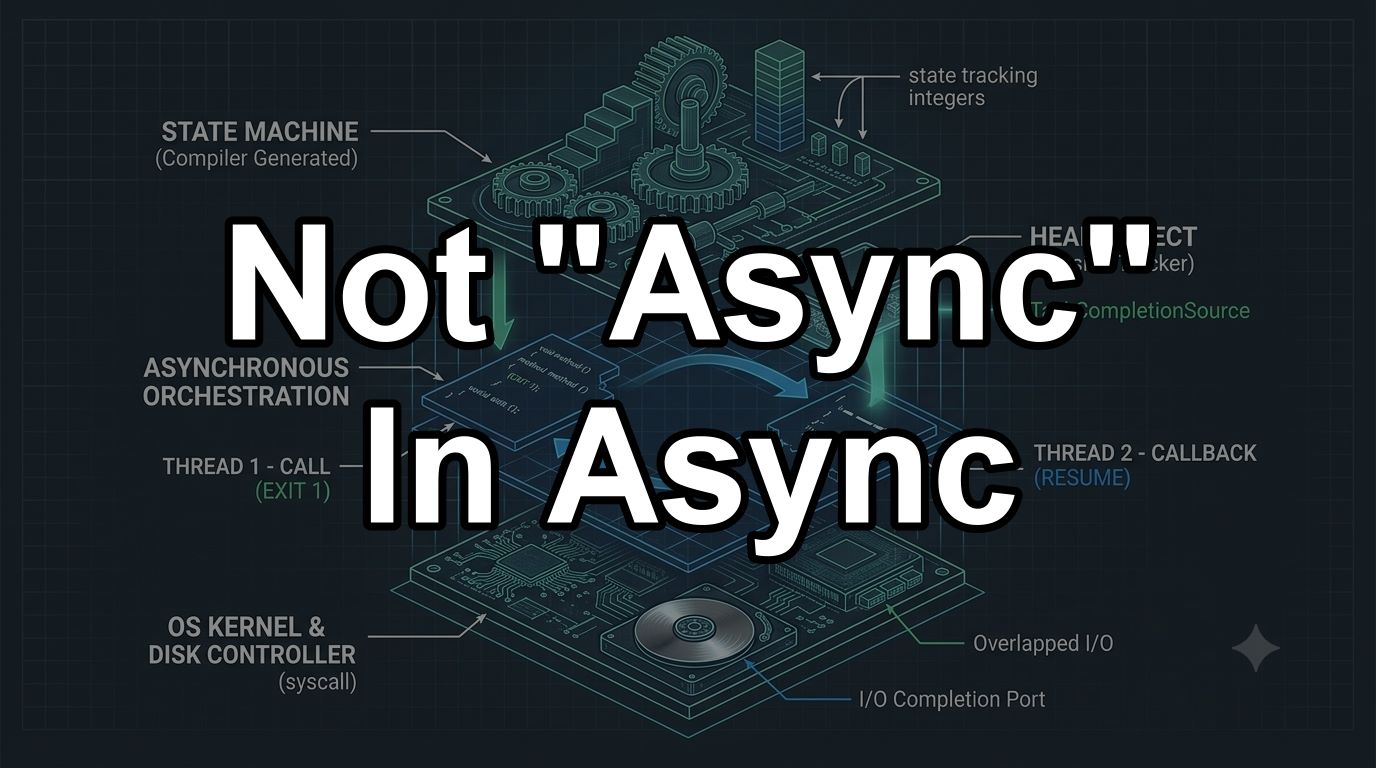
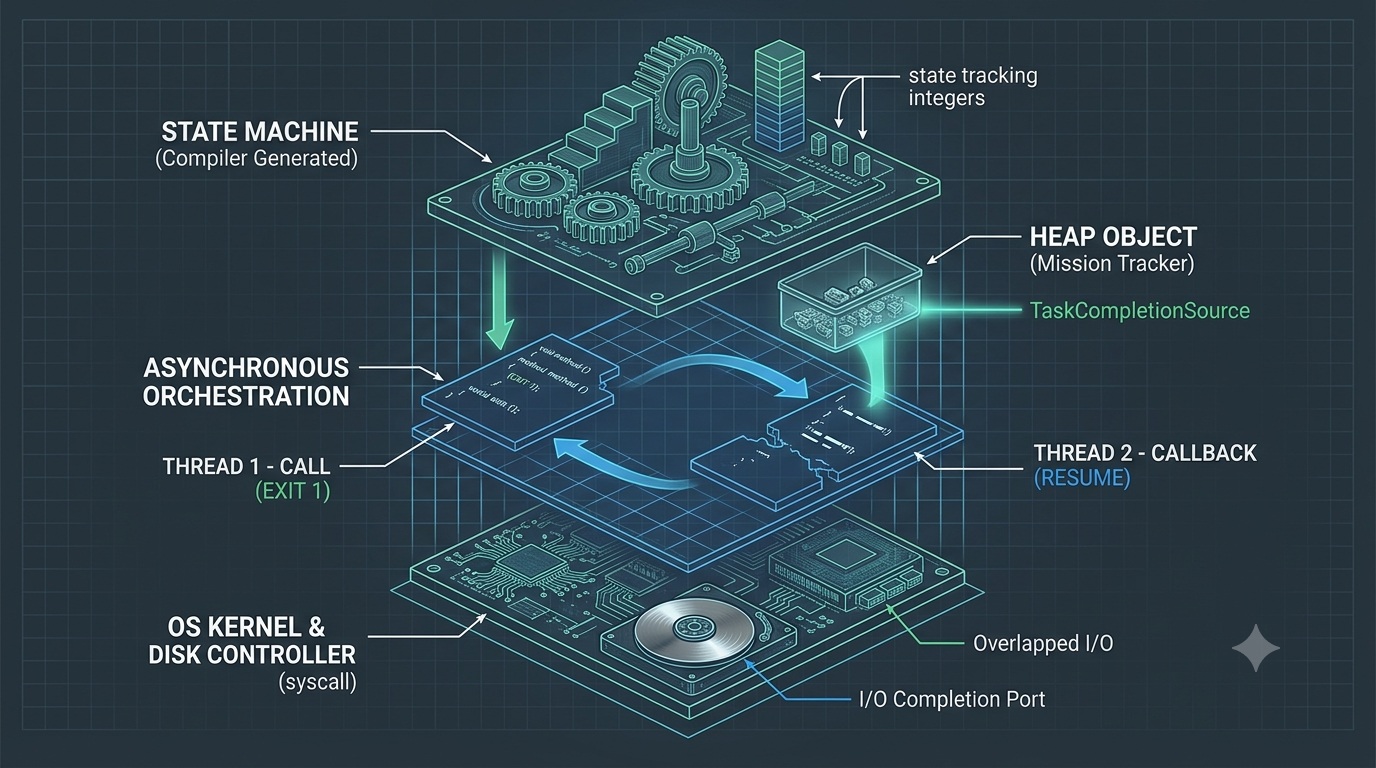
Open the hood of async/await and you will not find the async. You will find a compiler-built state machine, an ordinary object on the heap, and a single non-blocking call to the operating system — plain mechanics, arranged into a pattern. The pattern is what we named “async”. This article opens the hood, takes every component out, and shows you that nothing inside is magic.
Where we are in this series
The first article, Introduction of Asynchronous vs Synchronous Programming in C#, answered what async does: it releases threads during I/O waits so a small pool can serve many concurrent requests. The second article, The C# Async Cliff, answered when async is worth it: only past a measurable threshold of concurrency × wait time that most applications never reach.
By this point, you are familiar with async, comfortable, even. You see this block every day, and you can explain it smoothly:
public async Task<byte[]> DownloadReportAsync(string url)
{
    using var client = new HttpClient();
    byte[] data = await client.GetByteArrayAsync(url);   // thread released here
    return data;
}
Ask anyone what await does, and you will hear the standard answer: “it pauses the method and waits for the result without blocking the thread.”
That answer is good enough for daily work. It is also, word by word, wrong:
- It does not “pause the method” — methods cannot pause; they run to a return and end.
- It does not “wait” — nothing in your program waits.
- The thread is not “not blocked” — the thread is gone entirely, off doing other work.
The previous two articles described async from the outside — its purpose, its behavior, its economics. This article asks the question those articles deliberately postponed:
What is actually inside the async?
It’s not a car inside a car
Imagine a box with a label: CAR. You open the box, and you expect to find — literally — a car. The label told you so.
async is a label too. So when we open it, we expect to find… the async. Some component, somewhere, that is the asynchrony. The thing that does the pausing, the waiting, the magic.
But here is the problem: async isn’t a box. It’s a car. And what do you find when you open a car?
It’s springs, wheels, rods, coolant, a combustion engine, pistons, a fan, cables, a battery, a crankshaft, pipes, lots of gears… Point at any single component and ask “is this the car?” — the answer is no, every time. There is no car inside the car. “Car” is the name we gave to the pattern of all those parts working together.
Same here. There is no “async” inside async.
What’s inside is a combination of ordinary functions and ordinary objects, moving around and rearranging themselves in a specific working mechanism — and that pattern is what we call “async”. This is why “what is async” and “how does async work” always sound like two unrelated subjects. They are two different levels of description — just like “a car carries passengers” and “combustion pushes pistons” are both true statements about the same machine that share not a single word.
This article is the engine teardown. By the end, you will have held every component in your hands, confirmed that none of them is “the async”, and watched the pattern assemble itself in front of you.
But before we open the hood, there are three crucial concepts to install first. They are deep mechanisms that work across all programming languages — and they are, quite literally, the piston, the crankshaft, and the fuel of everything that follows.
Prerequisite 1: Memory on the stack vs memory on the heap
This is the concept the entire article stands on. If this one clicks, everything downstream becomes obvious. So we take our time here.
Your program has two kinds of memory, and you already use both every day without naming them:
class LibrarySystem
{
    // ── MEMORY ON THE HEAP ──
    // Belongs to the APPLICATION itself.
    // Lives as long as the application lives.
    // No method owns it. No thread owns it.
    // Any method, on any thread, at any time, can reach it.
    static int TotalBooks = 0;
    static string AppName = "Library System";
    static List<Book> Books = new List<Book>();

    // ── MEMORY ON THE STACK ──
    // Belongs to ONE method call, running on ONE thread.
    // Born when the method starts. Wiped when the method ends.
    public static void AddBook()
    {
        int newId = TotalBooks + 1;     // stack — born here
        string title = "C# Async";      // stack — born here

        TotalBooks = newId;             // heap — survives this method

    }   // ← the method ends HERE.
        //   newId and title are WIPED. Gone. No trace.
        //   TotalBooks lives on, holding the new value.
}
The ownership rule, in one sentence — memorize this one:
The stack belongs to the thread. The heap belongs to the application.
When a method ends, its stack memory is wiped. When a thread is released, everything on its stack is wiped — every method frame, every local variable, the whole whiteboard erased. But the heap doesn’t care about threads. Heap objects survive no matter which threads come and go.
One more detail before we move on, because it matters enormously later: when you write new Book() inside a method, the Book object is actually created on the heap — only the small reference to it sits on the stack. So “moving data to the heap” is not exotic. Your code does it constantly, every time you write new.
Watch the fate of each variable here:
public static void AddBook()
{
    int newId = TotalBooks + 1;     // stack — dies instantly when the method ends

    string title = "C# Async";      // the REFERENCE is on the stack;
                                    // the string OBJECT is on the heap

    Book b = new Book(title);       // 'b' (the reference) dies with the method...
                                    // but the Book object is on the heap.
                                    // What happens to it?

    Books.Add(b);                   // the heap List now holds the Book → it survives
}   // ← stack wiped HERE, instantly, for free.
    //
    //   But wait — if we had NOT called Books.Add(b)...
    //   the Book object would still be sitting on the heap,
    //   with nobody holding it. Who cleans THAT up?
Who cleans that up? — the Garbage Collector
In programming — every language — every piece of memory created must eventually be freed. In C, the programmer does this cleanup manually, by hand, and forgetting is one of the oldest bugs in computing. C# made a different choice: the runtime includes a Garbage Collector (GC) that does it for you.
The GC’s territory is the heap, and only the heap. It runs at intervals scheduled by the runtime, walks the heap, finds objects that nothing references anymore — like our orphaned Book, if Books.Add(b) had never been called — and frees them. It works so silently in the background that most C# programmers go years without ever thinking about it. That is the whole point of its existence. (The GC has its own deep mechanics, generations, edge cases, and even ways memory can still leak past it — that’s worth its own article another day.)
The stack, though, needs no garbage collector at all. When a method ends, its stack frame is destroyed in that same instant — automatically, with zero cost, no cleanup job scheduled, no waiting. newId and title‘s reference were never the GC’s business; they were already gone at the closing brace, for free.
So the two memories have opposite personalities:
- Stack: free and instant, but fragile. Cleanup costs nothing — but everything dies the moment the method ends or the thread is released.
- Heap: survives anything, but every object is a debt. It outlives methods and threads — but every object created is a future cleanup job for the GC.
And notice what Books.Add(b) did: a reference is what keeps a heap object alive. The List holding the Book is the only reason the GC leaves it alone.
Remember this trade, because the entire async machine is one big exercise in it: taking variables that would normally die on the stack, and deliberately storing them in a heap object instead — so they survive after the thread is gone. And remember the price tag, because we will present the bill at the end.
Prerequisite 2: Methods you can hand over — the callback
In C#, a method is not only something you call. A method is also something you can point at, store in a variable, pass to someone else, and let them call it later — possibly long after your own code has finished and gone home.
The official C# name for “a variable that holds a method” is a delegate. You have used them even if you never said the word:
// A variable that holds a METHOD, not a value.
Action<string> printer = Console.WriteLine;

// Whoever holds the variable can invoke the method — whenever they choose.
printer("hello");    // prints: hello
Now the pattern that matters to us. When you hand a method to someone else so they can call it when something finishes, that handed-over method is called a callback.
The everyday picture: you call a busy office. Instead of holding the line, you say “here is my phone number — call me back when you have the answer” and you hang up. You are free immediately. The number you left behind is the callback. Later — maybe minutes later, when you are in the middle of something else entirely — they call you.
In code:
// We hand RunReport a method ("our phone number")...
public static void StartReport()
{
    ReportEngine.RunReport(salesData, OnReportDone);   // hand over the callback
    // ...and we are FREE immediately. StartReport ends here.
}

// ...and the engine calls US back, later, when the report is ready.
// Note: by the time this runs, StartReport has long since ended.
static void OnReportDone(Report result)
{
    Console.WriteLine($"Report ready: {result.PageCount} pages");
}
Two things to burn in:
- Handing over a callback and the callback running are two separate events, separated in time. One is now; the other is later.
- Only the data and the resume point are handed over — the code is not copied anywhere. A delegate is a small pointer-like object saying which method to run; the method’s code stays where it always was, compiled once. (Hold this thought — it kills a popular misconception about state machines later.)
And one connection back to Prerequisite 1: between “handed over” and “called back”, where does the callback live? It cannot live on your stack — your method ended; your stack frame is wiped. The delegate is an object on the heap, kept alive by whoever holds the reference. The two prerequisites are already working together.
The spotlight: who calls whom
Step back and notice what the callback actually changed, because it is bigger than a convenience.
Two programs can talk to each other. They do it by invoking each other’s public API — the methods one program deliberately exposes for outsiders to call. Your C# application does this constantly with the biggest “other program” of all: the operating system. Every file read, every network packet, every memory allocation is your program invoking an exposed OS method — a system call.
Traditionally, this conversation has a fixed direction, decided when the code was written: your program is always the caller, the OS is always the callee. You ask; it answers. You ask again; it answers again. The direction is hardcoded — the OS has no way to start a conversation with you, because it doesn’t know any of your methods.
The callback breaks this. By passing a method reference as a parameter — chosen dynamically, at runtime — you teach the other party one of your methods. And from that moment, the calling direction reverses: the callee becomes the caller. The OS — a completely separate program, running in a privileged world your code cannot even see — now holds a phone number inside your application, and at a moment of its choosing, on a thread of its choosing, it dials it.
Software engineering has a name for this reversal — Inversion of Control — and a nickname that says it better: the Hollywood Principle. “Don’t call us. We’ll call you.”
Hold this picture, because the next prerequisite is exactly this principle in action.
Prerequisite 3: The OS call that answers twice
The first two prerequisites were about your program. This one is about the floor your program stands on: the operating system — the other party from the spotlight above. And it is the only place in this whole story where the asynchrony is physically real.
Normally, when your thread asks the OS to read a file or a socket, the call blocks: the OS suspends your thread until the data arrives. One question, one answer, and your thread stands frozen in between.
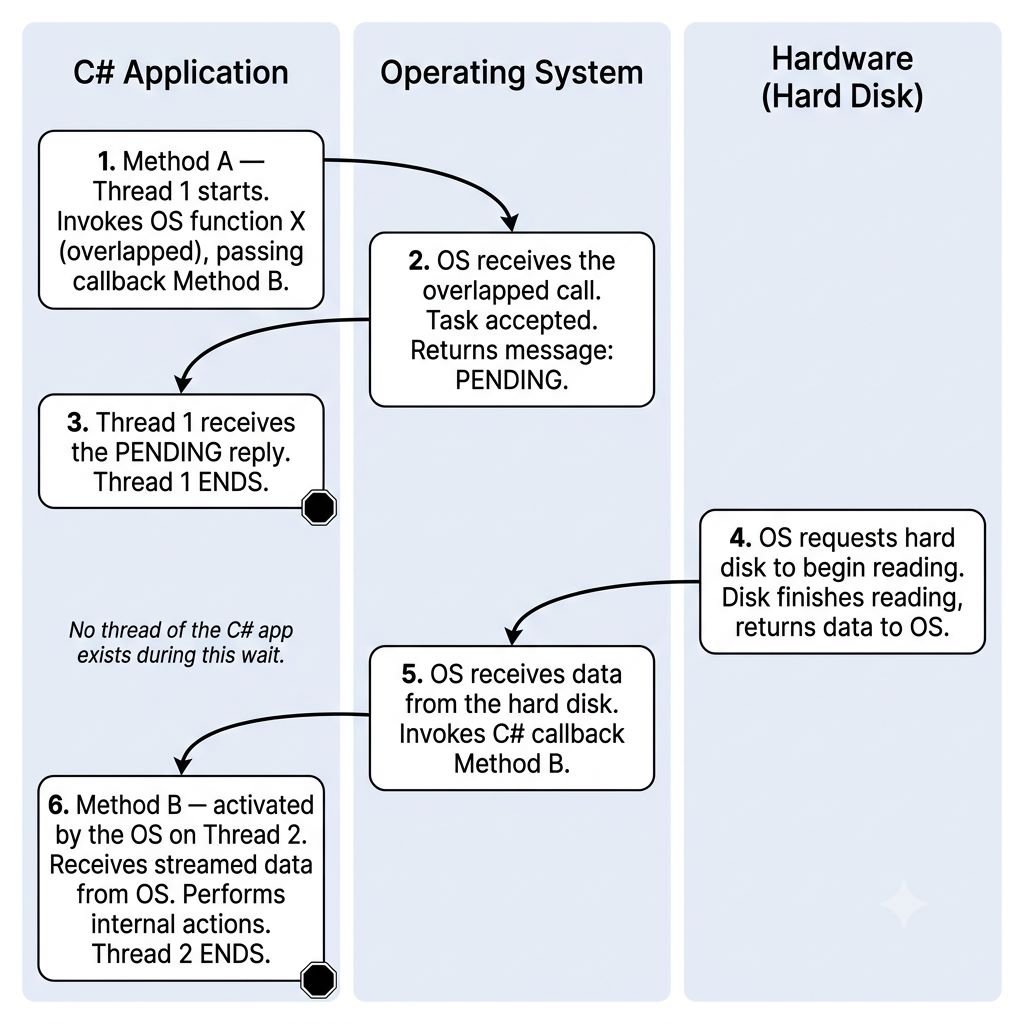
But the OS offers a second mode. Windows calls it overlapped I/O; Linux has epoll/io_uring; the idea is the same everywhere. In this mode, the same request gets two answers, at two different times:
🟢 Metaphor. Synchronous is a phone call where you stay silent on the line until the other person finds the answer. Overlapped is the voicemail from Prerequisite 2: you leave the request plus your callback number, and you hang up. Two separate events follow: the beep confirming your message was received (instant), and their return call with the answer (later).
🔵 Precise. Two distinct events, two different mechanisms:
- Answer #1 — immediately: the call returns at once with a status meaning “PENDING — I have accepted the work.” Your thread gets itself back in microseconds. Nothing has been read yet; the disk hasn’t even spun.
- Answer #2 — later: when the hardware has delivered the bytes, the kernel invokes the callback you registered — on a thread it supplies, not yours. Yours is long gone.
This is not one function “returning twice” — no function can do that. It is one return (PENDING) plus one callback (the result) — the Hollywood Principle, performed across the program/OS boundary: don’t call us asking “is it done yet?”; we’ll call you. Between the two answers, no thread of yours exists for this work. The kernel and the disk controller hold the entire wait. That stretch — kernel → completion queue → hardware → kernel — happens completely outside your program.
And now the three prerequisites snap together into one inevitable conclusion. If your thread leaves after Answer #1, its stack is wiped (Prerequisite 1). So any state the callback will need at Answer #2 — which file, which buffer, what to do next — must be stored on the heap (Prerequisite 1), and the resume logic must be handed over as a callback (Prerequisite 2), because the OS only offers this two-answer mode on those terms (Prerequisite 3).
The heap is where state survives. The callback is how the program resumes. The OS call is who does the waiting.
Piston, crankshaft, fuel. Now we can build the engine.
The whole machine in miniature
Here is the entire async mechanism, built by hand, with every moving part visible. This is a scale model — deliberately simplified, not the real API — and after it, Parts 1 to 5 will put each component under the microscope at full size. (The 🟢 metaphor / 🔵 precise pairs continue throughout: read the green to get it, the blue to get it right.)
The mission: read a file, write it to a new location, without any thread of ours waiting on the disk.
We know from the prerequisites exactly what the design must be: state on the heap, a callback handed to the OS, and the OS’s two-answer call doing the real wait. Like this:
// A plain object holding the FACTS of one in-flight mission — state only, no behavior.
public class MissionInfo
{
    public string OriginalFile = "";
    public string TargetNewFile = "";
    public int    ResumePoint   = 0;   // ← which step of the mission we paused at
}

class MyClass
{
    // The mission tracker — lives on the HEAP, owned by the application.
    // The references in this dictionary are what keep each mission alive
    // (exactly like Books.Add(b) kept the Book alive in Prerequisite 1).
    static Dictionary<int, MissionInfo> dicMissionInfo = new Dictionary<int, MissionInfo>();

    // ── PHASE 1 — runs on the calling thread, then leaves ──
    public static void ReadFile(string originalFile, string targetNewFile)
    {
        // Build the mission state...
        var missionInfo = new MissionInfo
        {
            OriginalFile  = originalFile,
            TargetNewFile = targetNewFile,
            ResumePoint   = 1            // "when resumed, continue from step 1"
        };

        int missionId = GetNewMissionId();

        // ...and store it on the HEAP, so it survives after this thread is gone.
        dicMissionInfo[missionId] = missionInfo;

        // t = 0ms ── THE TWO-ANSWER CALL (Prerequisite 3) ──
        // We hand the OS the job + our callback ("our phone number")...
        OS.ReadFileOverlapped(originalFile, missionId, OnBytesReady);
        // ...and the OS answers IMMEDIATELY: "PENDING — I took it."
        //
        // 🚪 EXIT #1 — this method ends right here, like any ordinary method.
        // The stack is wiped: missionId, the local missionInfo reference — gone.
        // The THREAD is released, free to serve anyone.
        // But the MissionInfo object lives on — the dictionary holds it.
    }

    //        ... t = 0ms → t = 200ms ...
    //        no thread of ours exists for this mission.
    //        The kernel and the disk controller hold the entire wait.

    // ── PHASE 2 — t = 200ms, ANSWER #2: the OS calls our number ──
    // This runs on a thread the OS supplies. Our original thread is long gone —
    // it might be serving its 50th unrelated request by now.
    static void OnBytesReady(int missionId, byte[] data)
    {
        // 🚪 ENTRY #2 — recover the saved state from the heap...
        var missionInfo = dicMissionInfo[missionId];

        // ...check where the mission paused, and continue from EXACTLY that step.
        switch (missionInfo.ResumePoint)
        {
            case 1:
                System.IO.File.WriteAllBytes(missionInfo.TargetNewFile, data);
                break;
                // (a longer mission would have case 2, case 3... —
                //  one case per pause point, ResumePoint updated at each pause)
        }

        // Mission accomplished. Remove the reference...
        dicMissionInfo.Remove(missionId);
        // ...and now NOTHING references the MissionInfo.
        // The GC will reclaim it — that's the heap debt from Prerequisite 1, paid.
    }
}
Walk the timeline once more, because this is async, all of it:
- t = 0ms. Phase 1 builds the mission state, parks it on the heap, hands the OS the job plus the callback, receives Answer #1 (PENDING), and ends. The thread is freed — not by some special release command, but the ordinary way every method frees its thread: by having nothing left to do.
- t = 0 → 200ms. Zero threads. The mission exists only as a heap object and a promise from the kernel.
- t = 200ms. Answer #2: the kernel invokes the callback on a thread it supplies. The callback recovers the state from the heap, reads
ResumePoint, jumps to the exact step where the mission paused, and finishes the job.
And notice what that ResumePoint + switch is: a method that appears to pause in the middle and resume from the same spot — built from nothing but a heap object, an integer, and a callback. We just hand-built a crude state machine. Hold that word.
What the real C# machinery automates
When you write a real async method, the compiler and runtime build exactly this — just better:
- Your hand-written
MissionInfo→ a compiler-generated state machine: your local variables lifted into its fields (heap-survivable), yourResumePointbecomes its_stateinteger, yourswitchbecomes itsMoveNext()method. - Your dictionary → unnecessary; the callback registration itself holds the reference that keeps the state machine alive.
- Your
OnBytesReady→ the runtime’s continuation plumbing, ultimately reached through the same OS two-answer call. - And what the state machine stores is data and a position — never the code. Your methods are not “copied into” the object (Prerequisite 2: a callback is a pointer to code, not the code). The compiler slices your method into segments at compile time, once; the heap object only remembers which segment is next.
That is the entire machine, in miniature. Now the teardown: Parts 1 to 5 take each component of the model and examine the real, full-size version — starting at the very bottom, where there is nothing left to trust.
Part 1: The bottom of the stack — proving the two-answer call is real
In the model, this was the line OS.ReadFileOverlapped(...) — one made-up function we asked you to take on faith. Here is the real one, with the faith removed.
Every library example just relocates your trust. File.ReadAllBytesAsync trusts FileStream, which trusts the runtime, which trusts a syscall. You can keep asking “but how do you know that one is real?” until you reach the operating system boundary — and the only honest way to see real async is to stand at that boundary and call it yourself.
Here is a file read written with raw Win32 P/Invoke. It does the exact work File.ReadAllBytesAsync does under the hood, with every comfortable wrapper stripped off.
using System;
using System.IO;
using System.Runtime.InteropServices;
using System.Threading;
using System.Threading.Tasks;
using Microsoft.Win32.SafeHandles;

public class NativeAsyncFileReader
{
    // ── STEP 1: Import the OS functions directly from the kernel's DLL ──
    [DllImport("kernel32.dll", SetLastError = true, CharSet = CharSet.Unicode)]
    private static extern SafeFileHandle CreateFile(
        string lpFileName, uint dwDesiredAccess, uint dwShareMode,
        IntPtr lpSecurityAttributes, uint dwCreationDisposition,
        uint dwFlagsAndAttributes, IntPtr hTemplateFile);

    [DllImport("kernel32.dll", SetLastError = true)]
    private static extern unsafe bool ReadFile(
        SafeFileHandle hFile, byte* lpBuffer, uint nNumberOfBytesToRead,
        IntPtr lpNumberOfBytesRead, NativeOverlapped* lpOverlapped);

    private const uint GENERIC_READ          = 0x80000000;
    private const uint FILE_SHARE_READ       = 1;
    private const uint OPEN_EXISTING         = 3;
    private const uint FILE_FLAG_OVERLAPPED  = 0x40000000; // the bit that means "two-answer mode"
    private const int  ERROR_IO_PENDING      = 997;        // ANSWER #1: "I took it"

    public unsafe Task<byte[]> ReadFileNativeAsync(string filePath, int bytesToRead)
    {
        // A hand-made container we will hand to the caller now and fill in later.
        // (Part 3 examines this component.)
        var tcs = new TaskCompletionSource<byte[]>();

        // ── STEP 2: Open the file in two-answer mode ──
        // FILE_FLAG_OVERLAPPED tells the KERNEL this handle behaves asynchronously.
        SafeFileHandle handle = CreateFile(
            filePath, GENERIC_READ, FILE_SHARE_READ, IntPtr.Zero,
            OPEN_EXISTING, FILE_FLAG_OVERLAPPED, IntPtr.Zero);

        if (handle.IsInvalid)
            throw new IOException($"Open failed. Win32 error: {Marshal.GetLastWin32Error()}");

        byte[] managedBuffer = new byte[bytesToRead];

        // ── STEP 3: Wire the handle to the OS completion queue (IOCP) ──
        ThreadPool.BindHandle(handle);

        // ── STEP 4: Register the callback WITH THE KERNEL (Prerequisite 2, for real) ──
        // It does NOT run now. The OS will run it later, on a thread we never started.
        var overlapped = new Overlapped();
        NativeOverlapped* native = overlapped.Pack((errorCode, numBytes, ov) =>
        {
            try
            {
                if (errorCode == 0)
                    tcs.SetResult(managedBuffer);   // ← fills the container handed out earlier
                else
                    tcs.SetException(new IOException($"Async read failed: {errorCode}"));
            }
            finally
            {
                Overlapped.Free(ov);
                handle.Dispose();
            }
        }, managedBuffer);

        fixed (byte* pBuffer = managedBuffer)   // pin so the kernel can write straight into it
        {
            // ── STEP 5: Issue the read — THE HAND-OFF ──
            // Because of the overlapped flag, ReadFile does NOT wait for the disk.
            bool immediate = ReadFile(handle, pBuffer, (uint)bytesToRead, IntPtr.Zero, native);
            int err = Marshal.GetLastWin32Error();

            if (!immediate && err != ERROR_IO_PENDING)
            {
                Overlapped.Free(native);
                handle.Dispose();
                throw new IOException($"Read init failed. Win32 error: {err}");
            }
            // err == ERROR_IO_PENDING → ANSWER #1, live and real.
            // The kernel owns the operation now. This thread is completely free.
            // Nobody is waiting on the disk.
        }

        // Return the not-yet-filled container immediately. Zero threads are blocked.
        return tcs.Task;
    }
}
Read the comments in order — they are the six steps. The thing to notice is Step 5 and what comes after it. ReadFile returns instantly with ERROR_IO_PENDING. That return code is Answer #1 from Prerequisite 3, no longer a metaphor: the kernel saying “I have accepted the work and given you your thread back; I will call your number when it’s done.” The method then flows straight to return tcs.Task and ends.
That is real async, with nothing left to trust. There is no Async method here to take on faith — ReadFile is a syscall, FILE_FLAG_OVERLAPPED is a bit the kernel checks, and ERROR_IO_PENDING is the kernel handing your thread back. Past this line there is no more C#; there is only the kernel and the disk controller.
So: is this component the async? It’s a function that returns a number. No. Keep the hood open.
Part 2: The method that exits twice
In the model, these were the two doors: 🚪 EXIT #1 at the end of Phase 1, and 🚪 ENTRY #2 at the top of Phase 2. Here is what they really are.
Look at ReadFileNativeAsync above and ask: how many times does control leave this method?
The answer is two, and they are completely different events separated in time.
You have already seen this shape — it is the voicemail from Prerequisite 3, now happening in real code. The first exit is the beep: your message is received, you hang up, you are free. The second exit is their return call, later, when the answer exists.
🔵 Precise. The first exit is return tcs.Task — the method returns an incomplete Task<byte[]> to the caller and ends, releasing its thread the ordinary way: by finishing. The second “exit” is not a return from this method at all (that already happened); it is the registered callback firing later, on an OS completion thread, executing tcs.SetResult(managedBuffer) — which flips the previously-returned Task from incomplete to complete and publishes the data into it.
The two timelines, drawn out:
First exit  (Timeline A — instant, on your calling thread):
    Step 5 fires the read → kernel says PENDING (Answer #1)
    → return tcs.Task → thread released

         ... meanwhile, outside your program entirely:
             the disk controller reads the bytes, the kernel waits on hardware ...

Second exit (Timeline B — later, on an OS thread you never created):
    kernel posts completion (Answer #2) → OS thread runs the callback
    → tcs.SetResult(bytes) → the Task handed out in Timeline A is now full
This is the whole secret in one sentence: the method hands out an empty container and leaves; something else fills the container later. Control flow (your thread leaving) and data flow (the bytes arriving) have been split into two independent events. The Task is the only thing connecting them.
Is the two-exit dance the async? It’s an early return plus a callback — Prerequisites 2 and 3, nothing more. No. Next component.
Part 3: What Task and TaskCompletionSource actually are
In the model, this component didn’t exist yet — Phase 1 returned nothing, so the caller had no handle on the mission. The Task is that missing handle — the empty container from Part 2, finally examined up close.
There is a temptation to imagine Task as something alive — a little engine running your work in the background. It is nothing of the sort.
🟢 Metaphor. TaskCompletionSource is a parcel locker. You’re given an empty locker and its key (tcs.Task) right now. The locker just sits there. Later, a delivery driver (the OS completion thread) opens it with their copy of the key and drops the parcel in. The locker never did anything — it held a space.
🔵 Precise. Task and TaskCompletionSource are ordinary objects on the heap — Prerequisite 1 objects, kept alive by whoever references them. A Task holds fields: a status flag (IsCompleted), a result slot, and a list of continuations — callbacks to run when the status flips (Prerequisite 2 again: a list of phone numbers to dial on completion). It consumes zero CPU and holds zero threads while “waiting.” A Task is not a unit of execution; it is a state cell with a notification list.
When a caller does await readTask and the task is not yet complete, here is what physically happens: the caller adds its own continuation to that list (“when this flips, run the rest of my method”) — and then the caller’s execution path also ends and releases its thread. Now there are zero threads anywhere associated with this read. The Task sits dormant on the heap. The disk controller moves the bytes. Nobody waits in any programmatic sense — no thread is parked anywhere burning a stack.
When tcs.SetResult(bytes) finally runs on the OS completion thread, it does two mechanical things: drops the bytes into the result slot, and flips IsCompleted to true. The flip triggers the notification list — the runtime grabs any pool thread and dials every number on it.
Is the Task the async? It’s an object with a boolean and a list. No. One component left — the big one.
Part 4: The compiler deletes your method
In the model, this was ResumePoint and the switch in OnBytesReady — our crude trick for “continue from the exact step where we paused.” Here is the industrial-strength version, and it is the deepest part of the teardown.
The manual code in Part 1 used a hand-written TaskCompletionSource. But when you write a normal async method, you write none of that — you just write await. So where does the park-and-resume machinery come from?
From the most surprising mechanic in this whole story: the C# compiler deletes your method and rebuilds it as a class.
The problem it must solve is pure Prerequisite 1. In synchronous code, “where am I in this method” and “what are my local variables” both live on the thread’s stack. Release the thread and the stack is wiped — you lose your place and your data. So to survive a thread release, your place and your data must move to the heap.
🟢 Metaphor. The compiler turns your method into a board game with a save-game file. Your local variables become slots in the save file. A little number records which square you were standing on. When you must leave the table, you don’t lose progress — the game is saved to disk. Anyone can sit down later, load the save, and continue from the exact square, all your pieces where you left them. (And note what the save file does not contain: the rulebook. The rules — your code — were printed once, at compile time. The save only stores positions.)
🔵 Precise. The compiler generates a hidden state-machine type. Every local variable becomes a field on that type (heap-survivable). An integer _state field records which await was last reached — the real ResumePoint. The method body is chopped into segments at each await, and the segments are wrapped in one method, MoveNext(), that branches on _state — the real version of our switch.
Here is the shape of what the compiler produces — simplified for teaching, not literal compiler output:
// You write:
public async Task<string> ProcessFileAsync()
{
    int userId = 42;
    string path = "config.dat";
    byte[] data = await FetchNativeAsync(path);     // ← the slice point
    return $"User {userId} processed {data.Length} bytes";
}

// The compiler DELETES that method and generates (conceptually) this:
private class ProcessFileAsync_StateMachine
{
    // 1. Local variables become FIELDS — they now live on the heap and survive.
    public int    userId;
    public string path;
    public byte[] data;

    // 2. The bookkeeping — our MissionInfo.ResumePoint, industrialized.
    public int _state = 0;                              // which segment are we on
    public AsyncTaskMethodBuilder<string> builder;      // wires up the Task (Part 3)
    private TaskAwaiter<byte[]> _awaiter;

    // 3. The engine — our switch in OnBytesReady, industrialized.
    //    Called once to start, then AGAIN each time an await completes.
    public void MoveNext()
    {
        if (_state == 0)
        {
            userId = 42;
            path   = "config.dat";

            _awaiter = FetchNativeAsync(path).GetAwaiter();
            if (!_awaiter.IsCompleted)
            {
                _state = 1;                             // SAVE: remember we paused here
                // "When the inner task completes, call MoveNext again."
                // ← MoveNext handed over as a CALLBACK (Prerequisite 2)
                builder.AwaitUnsafeOnCompleted(ref _awaiter, ref this);
                return;                                 // 🚪 EXIT #1 — thread released
            }
        }

        if (_state == 1)                                // 🚪 ENTRY #2 lands here
        {
            data = _awaiter.GetResult();                // userId is STILL 42 — it's a field
            builder.SetResult($"User {userId} processed {data.Length} bytes");
        }
    }
}
Trace it against the miniature model:
- Start. You call
ProcessFileAsync(). The runtime creates a state-machine instance, sets_state = 0, and callsMoveNext()once. - First segment. It runs your code up to the
await, fires the inner operation, sees it isn’t done, saves_state = 1, registersMoveNextas the callback, and returns. The thread is released — Exit #1. - The park. No thread exists for this work. But
userId = 42andpathare safe — they are fields on a heap object, not stack slots. The callback registration is the reference keeping that object alive (no dictionary needed — the registration is theBooks.Add(b)). - Wake-up. The inner operation completes — ultimately because the OS posted Answer #2, exactly as in Part 1. The runtime grabs any pool thread and calls
MoveNext()again — Entry #2. - Resume.
_stateis 1, so the first block is skipped entirely. Execution lands in the second segment.userIdis still 42, because it was never on a stack that could be wiped. The method finishes and publishes its result through the builder into the Task.
That is “pause in the middle and resume from the exact spot.” Nothing paused. The method was sliced into segments at compile time, your progress and variables were saved into a heap object, the method exited early to free the thread, and the OS-driven completion called back in to run the next slice.
await is the keyword that tells the compiler where to put the slice boundaries. That is all it is.
Is the state machine the async? It’s a heap object with an integer and a switch — our MissionInfo with a better tailor. No. The hood is now fully open, and we have run out of components to suspect.
Part 5: The bill — what the machine costs
One question remains before we close the hood: is one of these state machines built on every async call?
Yes. Every invocation of an async method creates its own state-machine instance. A web server handling 10,000 concurrent requests, each calling five nested async methods, has roughly 50,000 of these objects alive at once. They are small and idle, but they are real heap allocations — and Prerequisite 1 told us what every heap allocation is: a debt, payable to the GC.
The runtime works hard to keep the debt small:
🟢 Metaphor. The save-game starts as a scribble on a sticky note on your desk — fast, free, thrown away when you stand up. Only if you actually have to leave the table does someone copy it into the permanent filing cabinet.
🔵 Precise. For calls that complete synchronously (the awaited thing was already done, no real suspension), the state machine stays a struct on the stack — nearly free, wiped at the closing brace like any local, never the GC’s business. Only at the first genuine suspension does the runtime promote it to the heap — allocating the Task and copying the struct’s fields into a heap object — so it can outlive the released thread. (You will hear this promotion called “boxing” — technically the wrong word; boxing is a specific value-type-to-object conversion. This is the async builder lifting the state machine to the heap: a different mechanism with a similar shape.)
And here is the engineering consequence: that heap promotion is a cost, paid per suspended async call, in allocations the GC must later clean up.
Write a hot loop that awaits a tiny operation a million times, and you have minted a million heap objects in milliseconds — feeding the GC a workload that synchronous code would never generate, because synchronous code keeps its state on the stack, where cleanup is instant and free. This is the stack-vs-heap trade from Prerequisite 1, presented as an invoice: async deliberately moves state to the surviving-but-costly side, on every suspended call, whether or not the survival was worth paying for.
When you genuinely need thousands of concurrent waits without thousands of blocked threads, the trade is a bargain — the allocations are trivial next to the 1MB stacks you saved. When you don’t, you are paying a memory-and-GC tax to solve a problem you do not have. Which side of that line your system lives on is the entire subject of The C# Async Cliff.
One last door to open: it was never just one file read
This whole article followed a single mission — read one file — because one example, traced honestly from keyword to kernel, teaches more than ten examples traced halfway. But now that you’ve seen the full depth of one path, here is the full width: every async operation in C#, all the thousands of ...Async methods across the entire ecosystem, funnels down to a handful of OS entry points — and four of them carry nearly everything.
| What your C# is really doing | Windows (IOCP) | Linux | Typical C# methods that funnel here |
|---|---|---|---|
| File read | ReadFile (overlapped) | io_uring read* | FileStream.ReadAsync, File.ReadAllBytesAsync |
| File write | WriteFile (overlapped) | io_uring write* | FileStream.WriteAsync, File.WriteAllTextAsync |
| Socket receive | WSARecv (overlapped) | epoll + recv / io_uring | HttpClient.GetAsync, SqlCommand.ExecuteReaderAsync, NetworkStream.ReadAsync |
| Socket send | WSASend (overlapped) | epoll + send / io_uring | HttpClient.PostAsync, NetworkStream.WriteAsync |
| Socket connect | ConnectEx | epoll + connect | Socket.ConnectAsync |
| Socket accept | AcceptEx | epoll + accept | Socket.AcceptAsync (every Kestrel request starts here) |
| Pure time delay | kernel timer (no I/O at all) | kernel timer | Task.Delay |
- Before
io_uring, Linux had no true async file I/O at all — .NET quietly emulated it with pool threads. A “fake async” living inside the BCL itself, by necessity: where the OS offers nothing real, even Microsoft can only pretend. (The impostors from The Async Cliff go all the way down.)
Look at the funnel shape. At the top: every database driver, every HTTP library, every cloud SDK, thousands upon thousands of async signatures. At the bottom: four workhorse calls — file read, file write, socket receive, socket send — plus a few cousins for connecting, accepting, and timing. HttpClient.GetAsync? Peel the layers: HTTP is a conversation over a socket — WSARecv and WSASend. A SQL query? The same — TDS protocol over a socket. Reading a config file? ReadFile, the very call from Part 1. There was never anything else down here. Nothing fancy. The entire async universe stands on a doorway you can count on two hands.
And now read the table once more, because it is hiding the final twist of this article.
The OS does not call any of this “async.” Cross the boundary into the kernel’s world and the word changes: Windows calls it overlapped — named for what it physically is, your program’s work and the device’s work overlapping in time. Linux calls it readiness, completion, epoll, io_uring. Search the Win32 documentation for the feature we spent this whole article dissecting, and the word “async” barely appears — it was never the OS’s word.
“Async” is the name the language world invented for its end of the pattern — the keywords, the state machine, the Tasks. The OS end has its own name, because the label was never attached to a thing; each world named the pattern as it appears from where they stand. You cannot open the box and find “the async” for the deepest reason of all: even the word runs out before you reach the bottom.
Closing the hood: there is no async
The teardown is complete. Lay every component out on the workbench and look at what we found:
- A syscall that returns
PENDINGand calls a number later — a function and a callback. (Part 1) - A method that exits early and is re-entered by that callback — two ordinary events, separated in time. (Part 2)
- A
Task— a heap object with a boolean, a result slot, and a list of phone numbers. (Part 3) - A state machine — a heap object with your variables as fields, an integer bookmark, and a switch. (Part 4)
- A GC bill for every heap object the pattern mints. (Part 5)
Point at each one and ask the primary-school question: is this the async?
The syscall? No — it’s a function returning a number, and the OS doesn’t even call it “async” — it calls it overlapped. The callback? No — it’s a method handed over as a value. The reversed calling direction? No — Inversion of Control is a trick older than C# itself. The Task? No — it’s a box with a flag. The state machine? No — it’s a save-game file. The thread pool, the kernel, the disk controller? No, no, no.
There is no async inside async. Just like there is no car inside a car. Open the car and you find pistons, gears, coolant, a crankshaft — ordinary parts, none of which is “the car.” The car is the name of the pattern they form when assembled. And async is the name of the pattern these parts form: state moved to the heap so it outlives the thread, a callback registered so the program can resume, and one two-answer OS call so that the wait is held by the kernel — by nobody — instead of by a parked thread.
This is also why the two levels of explanation never sounded like the same subject. “Async lets a thread serve other requests during I/O waits” — true, and it’s the purpose-level description, like “a car carries passengers.” “Async is a compiler-built state machine resumed by an IOCP completion callback” — also true, and it’s the mechanism-level description, like “combustion pushes pistons.” Same machine. Two altitudes. Not a single shared word — and now you can speak both.
The final exhibit
After all that machinery, look at the same job — read a file, write it elsewhere — in the form every developer learned first:
class MyClass
{
    public static void ReadFile(string originalFile, string targetNewFile)
    {
        // thread waits here for the disk
        byte[] bytes = File.ReadAllBytes(originalFile);
        File.WriteAllBytes(targetNewFile, bytes);
    }
}
Two lines. No state machine, no heap promotion, no callback, no GC debt. One thread walks straight down the method, waits at line 1, continues at line 2 — and bytes lives safely on the stack the whole time, because the thread never leaves.
Put it next to everything in this article and the true shape of the choice appears. The synchronous version is not missing a feature. The asynchronous version is not an upgrade. They do the identical job. Every component on the workbench — the heap object, the bookmark, the callback, the two-answer call, the GC invoice — buys exactly one thing: during the wait, no thread waits. That is the entire product. Whether a freed thread is worth that machinery depends on how many threads you have and how long your waits are — the question that belongs to The C# Async Cliff, which begins where this teardown ends: with the hood open, the parts understood, and the bill itemized.
The hard part of async was never “how does it work.” You have now seen all of it, and none of it was hard — a save file, a phone number, and a kernel that answers twice. The hard part is judgment: knowing when the pattern earns its price. But judgment needs the mechanism first.
Now you have the mechanism. There is no magic in the engine bay — and there never was.
This article reconstructs async from the operating system upward, the way it was assembled in a long conversation that refused to accept “trust me, it’s async” at any layer — and kept asking, at each level, “but where is the thread, and who is actually doing the waiting?” The answer, every time, was the same: the OS does the waiting; C# only orchestrates the question. And the orchestration, taken apart, is just parts — the async was never inside.